A Peek Behind the Veil

The word “revelation” has its roots in a Latin word (revelatio) which means “to draw back” (re-) the “veil” (velum). Often we associate this word with the person who has gained knowledge. He or she has discovered something which was always present but unknown; like a tropical island or a chemical element. But what distinguishes a revelation from a discovery is that the latter can be made according to one’s own powers. The discoverer is the active agent in the process of detection. A revelation, on the other hand, needs to be given. It is the giver who is the active agent, who lifts the veil, and who allows the receiver to accept or reject what has been shown.

In today’s Gospel (Jn 10:27-30), Jesus offers his followers a revelation concerning his true identity. His disciples could not have “discovered” this on their own, nor are they compelled to believe what has been revealed. “The Father and I,” Jesus says, “are one” (Jn 10:30). It is difficult to describe, in both scope and depth, what this one little sentence must have inspired – or perhaps incited – among the Jesus’ Jewish audience. The Gospel states that at least some persons who were present “picked up rocks to stone him” (Jn 10:31). Indeed, to an audience accustomed to praying the Shema – “Hear, O Israel! The Lord is our God, the Lord alone!” (Dt 6:4) – this statement would approach the height of self-aggrandizing sacrilege. But Jesus neither recoils at the threat of stoning, nor demurs from the accusation of blasphemy. Rather, he confirms his previous statement by adding that “the Father is in me and I am in the Father” (Jn 10:38). In today’s Gospel, Jesus gives his disciples, if you will, a “peek behind the veil”; a glimpse of his identity which will only be known after his Resurrection and through the gift of the Spirit.

Christ Pancrator

Christ Pantocrator (mid-6th cen.) St. Catherine’s Monastery, Sinai

This revelation of Christ’s personhood is not a matter of abstract dogma, or of learning a fact like so much other data available to us in this “Information Age.” The demons “know” that Jesus Christ is Lord (e.g., Mk 1:24), and yet they revile him. Jesus’ mission of salvation is an embrace of the human person. He conquered death so that we might come to him and receive new life. As St. Paul writes: “the Son of God…has loved me and given himself up for me” (Gal 2:20; emphasis added). Nothing could be of greater importance for me, for my present life and eternal destiny, then Christ’s true identity. For if he and the Father are one, if he has conquered death, and if I am united to him as member of his body, then I too can proclaim: “Death is swallowed up in victory. Where, O death, is your victory? Where, O death, is your sting?” (1 Cor 15:54-55; cf. Hos 13:14).

Anthony Coleman teaches theology for Saint Joseph’s College Online.
Mother Teresa Was A Thin Place

I’ve never really thought of myself as a person who is overly concerned or even that aware of celebrity or celebrities.   In retrospect, it being 20/20, I can see that I’ve been fortunate to be in the right place at the right time on occasion.  Once, when I was a little girl, we were on a family vacation touring Washington D.C.  In simpler times when there were virtually no security concerns or precautions it was easy for a little girl to wonder into the Speaker’s Office where I was welcomed by Speaker of the House of Representatives,  Sam Rayburn,  who invited my stunned parents and older brother to come in and meet Senators Everett Dirksen and Charles Halleck.  After handshakes and gifts of House of Representatives pens and stationery we continued wondering the halls.  I realize now that a little girl who actually knew who those men were is just as unimaginable as a time that existed when that could actually happen. (My Father was very civic minded and talked to me about politics and just about everything else, like I was an adult.)

Once, as my Mother and I exited a performance of Funny Girl in New York, we noticed a crowd gathering across the street.  So we investigated and found Ginger Rogers signing autographs.  She had just completed her performance in Hello Dolly.  She touched my Mother’s face, patted me on the head and signed our Funny Girl program.  (Yes, it really happened.)

IMG_2051


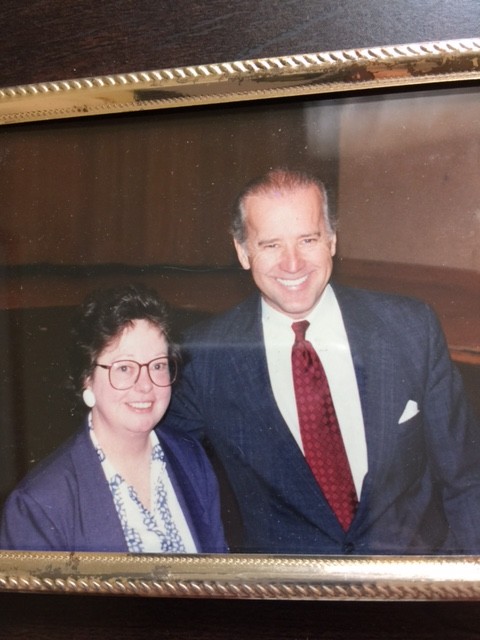
Teaching in a high school in a small state (Delaware) it was not uncommon to have elected officials visit.  Then Senator, Joe Biden lived not far from school and often visited.  Besides my memory I can actually document this occasion with a photo…


By far and away, however, the most profound meeting came when I was a novice many years ago.  Its impact on me has not waned over time and I can still close my eyes and experience the moment as if for the first time.  Cardinal O’Connor had invited Mother Teresa of Calcutta to speak at Saint Patrick’s Cathedral in New York City.  Our Mother House was several hours away in Pennsylvania.  Assuming that she would speak during Mass, perhaps at the post-communion, we did not attend Mass before we departed for New York.   We learned when we got there that she would be speaking shortly but not within the celebration of Mass.  She gave a wonderful message, elegant in its simplicity.  When she concluded the Cardinal graciously invited all present to a reception in the lower church.  We were informed by our superior that we would not be attending the reception since we had not yet attended Mass.   We would attend the Mass which was about to begin and depart immediately thereafter for PA.  We were, I must admit, not very devout, because we really wanted to meet Mother Teresa.  All present, except us, filed out of the cathedral to the reception, leaving us and a few others, to attend our Sunday Mass.

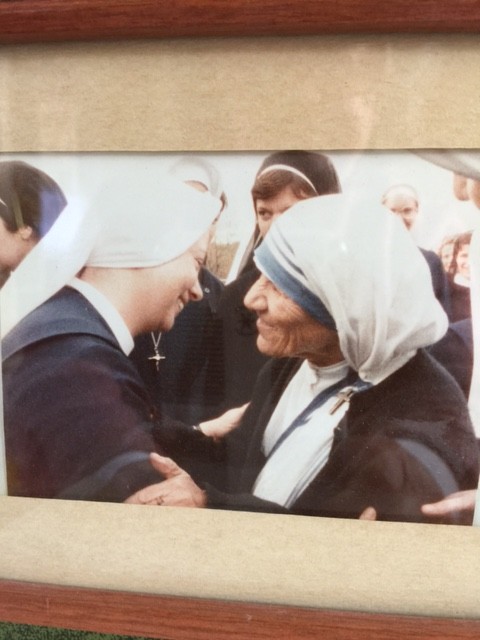
End of story?…oh no.  After Mass we piled back onto the yellow school bus and headed out of NYC and onto the New Jersey Turnpike.  About 30 miles down the Turnpike one of the novices in the back of the bus called loudly, “Mother Teresa’s in the car behind us!”  You would have thought someone had just spotted one of the Beatles.  We all stood and looked toward the back and sure enough there she was with a younger sister who was the driver.  Mother still had a dozen red roses on her lap that someone had given her at the Cathedral.    Just then the driver motioned for us to pull over.  So, at the next interchange we did just that.  I can’t imagine what the passersby on the turnpike thought.  We looked like a scene from the Sound of Music.  Can you imagine driving by and saying to your friend, “Is that Mother Teresa in the middle of that?”  Yes, and In the middle of all of that one of the novices began taking pictures as Mother Teresa graciously and gently hugged every one of us.  She offered her roses to us until they were gone.  She said that she was disappointed that we were not at the reception and that she had seen us in the cathedral and recognized out habits.  We explained about Mass.  We said our goodbyes and made our way back to our Motherhouse in PA.

IMG_2050For me the enduring effect of that meeting resides in the experience of grace.  The old Irish speak about the “thin places”.  Celtic spirituality holds that the separation between the natural and supernatural is very small and that in some cases very, very small.  These places are the thin places.  A thin place can be a place.  It can also be a person or an experience.  In this case, the thin place was Mother Teresa.  The experience while vivid is still ineffable, but I can say that I experienced a palpable sense of grace and I felt an urgency to be open to it.  I smile when I think of the details of this story, but I pray when I close my eyes and remember the grace.

Susan O’Hara teaches theology for Saint Joseph’s College Online.