Mary and Advent (Or, Why Legos Just Don’t Satisfy the Infinite Thirst for God)

My kids are into Legos right now. They are perhaps not my favorite toy, to which the bottom of my foot will testify.Legos

But Legos—excuse me, interlocking brick construction systems—are at least an interesting case-study in human desire. To wit: Kid A desperately wants Lego Set X. He thinks, speaks, and dreams of Lego Set X. He obtains Lego Set X—rejoicing! He constructs Lego Set X. It’s fun.

On the day after comes the Great Letdown. Onto desiring Lego Set Y!

We adults may not try to fill the God-hole in our hearts with Lego sets. Then again, maybe we do.

Or perhaps we go for more Grow out of legossophisticated alternatives. Like the iPhone 6. Or the right job. Or the great relationship. But we are still just overgrown kids, vainly throwing Lego bricks into an infinite hole and wondering why we still feel lousy.


All of this points to the providence of having the Feast of the Immaculate Conception right smack in Advent, on December 8. The season of Advent these days has become the time to advert to our infinite desire for God amidst and despite the relentless consumerism of December. The purity of Mary, which is the product of her Immaculate Conception, releases her to drink deeply from the only well that satisfies human thirst: the truth and love of the triune God.

Mary fully allows the Father to achieve what Fr. Robert Imbelli in his beautiful book Rekindling the Christic Imagination calls “Christification”:

Christians are called not merely to the imitation of Christ but to participation in his own life, gradually becoming transformed from their old self to the new self, recreated according to the image and likeness of their Savior, who loves them and, in the Eucharist, continues to give himself for them.

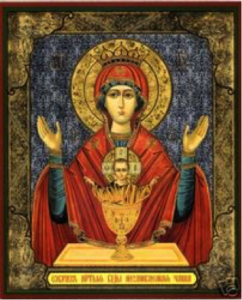
The icon is the Mother of God of the Inexhaustible Chalice, a classic Russian icon. Mary calls us to come and drink from that chalice that never runs dry, the eternicon 3al, self-giving love of her Son Jesus. Like Christ arising from the chalice, so are we, as little Christs, resurrected into the newness of Christian life by his Eucharist grace. The Christification that God has achieved in Mary, he wants to do for each of us. What Mary has allowed God to do for her, she wishes us to experience through her maternal care. And we will, if we say fiat as she did.
This, then, is the hope of Advent: the hope of transformation into Christ, the satisfaction of those infinite longings for the triune God. This is the hope we bring to others. “The New Evangelization is not about a program,” Fr. Imbelli writes, “but about a Person and about participation in the new life he enables.”

As cool as Legos are, that’s much, much better.

Angela Franks teaches theology for Saint Joseph’s College Online.


Like us on Facebook.
 

What Is Spirituality?

“Time and again, the Faith has to all appearances gone to the dogs.
But each time, it was the dog that died.”    —G. K. Chesterton

The categories we use may obscure understanding. Some are vague, unclear, and misleading. For example, religion, art, mysticism, and culture may be employed in different ways in tension with one another. The Catechism of the Catholic Church does not use “spirituality” in its account of a life in Christ. Only in the last 300 years has “spirituality” come into use. “Spirituality” was not used in the philosophical tradition of the West or in the biblical-theological tradition. The term “spirituality,” if not clearly defined, brings confusion. For example, in the present cultural malaise many say that they practice spirituality, but not religion, where spirituality is a positive, religion a negative.

Spirituality in its most general sense clearly has to do with human lived experience.

“the contents of the concept can be determined approximately in a positive sense as the practical or existential fundamental attitude of a person, the consequence and expression of his religious—-or, more generally, his ethically committed—understanding of existence: his life is entirely determined in what he does and in his state of being (habitus) by his objective insights into life and decision for life.”[1]

This view of spirituality applies to all, not just Christians. We speak of “Carmelite” spirituality, of Buddhist spirituality, of “lay” spirituality, but also of “spirituality for nurses.” This sets the human spirit at the center and emphasizes life’s specifically human dimension.

What is Christian Spirituality?

The adjective “Christian” substantively modifies “spirituality,” shifting focus from what happens within the spirit of an individual person over to that person’s relationship with God through Jesus Christ. According to Cunningham and Egan,

“Christian spirituality is the lived encounter with Jesus Christ in his spirit. In that sense, Christian spirituality is concerned not so much with the doctrines of Christianity as with the ways those teachings shape us as individuals who are part of the Christian community who live in the larger world.”[2]

What is Catholic Spirituality?

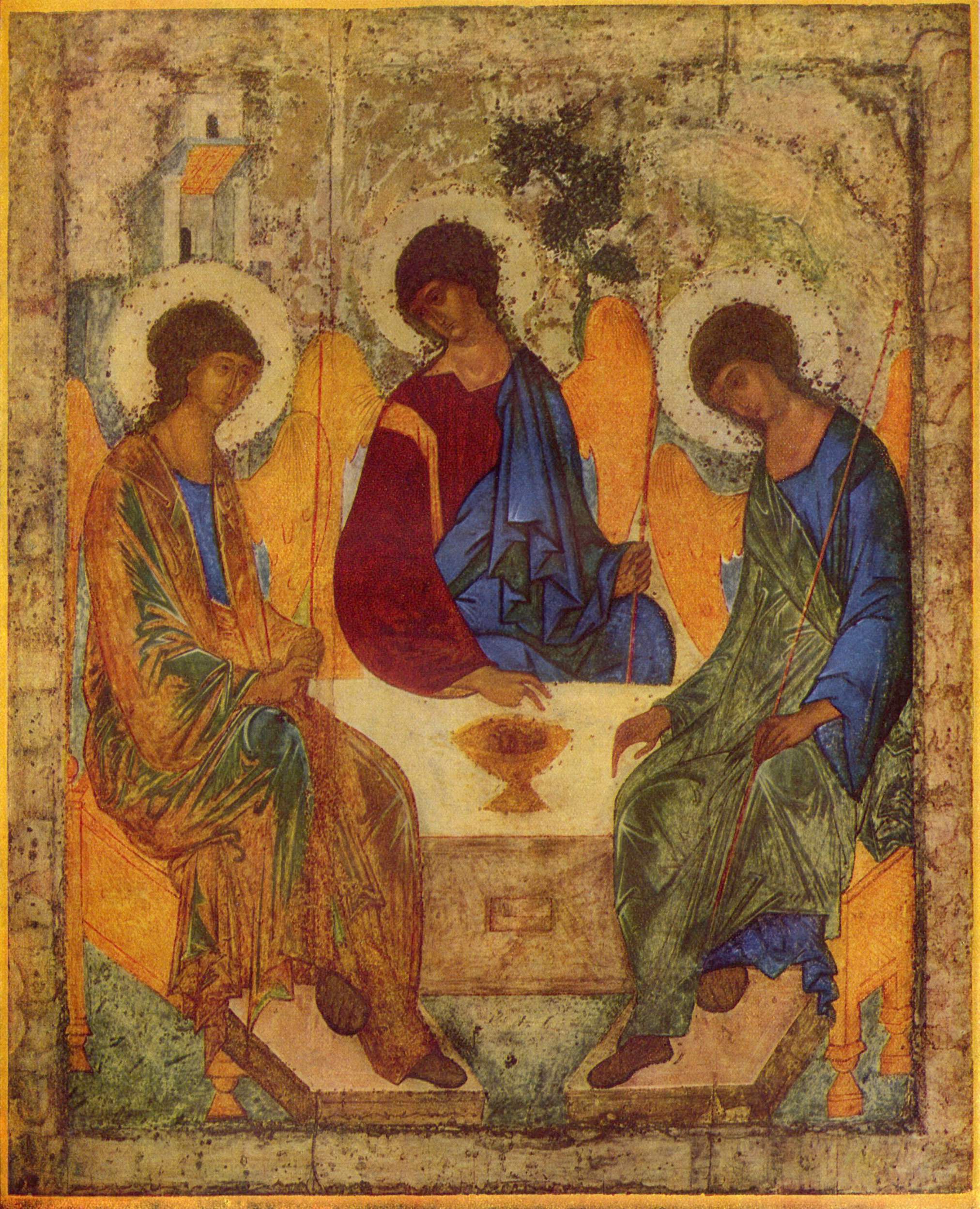
Andrej_Rublëv_001Should we speak of “Christian spirituality in the Catholic tradition,” or speak of “Catholic spirituality?” There is a historically rich tradition of spiritual writers quite conscious of being Catholic. They reflect the lived experience of being Catholic. The life of the Church is so substantively continuous that we can discern a “Catholic spirituality.” This Catholic spirituality coincides with that of the undivided Church for the first 1000 years, with the “Catholic Church” in the west for the next 500 years, and for the “Roman Catholic Church” for the 500 years since the Reformation. Catholic spirituality captures the essential dimension of Christian spirituality that is only captured when attention is drawn to the dimension that is “distinctively Catholic.” The distinctively Catholic dimension is its deep rootedness in a distinctive view of the catholicity of the Church and of the Catholic way of living.

“Catholic spirituality is a deep Christian way of living, practiced by the baptized members of the Catholic Church, which, through the power of the Holy Spirit, encounters Jesus Christ, the incarnate Son of the Father, and thus is conformed to Christ in the Holy Spirit to the glory of God the Father.” Catholic spirituality is thus not about a mere encounter with God. It is not merely about being a Christian. Its practice is about the life of the baptized believer within the Church, participating in the dynamic love of the Son for the Father in the inner life of the Triune God.

Spirituality or Spiritualities

There is one Catholic spirituality because the Church is one, holy, Catholic and apostolic, one body in Christ. Catholic spirituality is the practice of discipleship within the Church whereby one enters into the Triune life of God through Christ. Yet the Church has experienced a history of two thousand years. It lived through the end of antiquity, the medieval period, the tragedy of the Reformation, and the secularization of the modern period. These cultural situations call forth different forms of discipleship. The one Catholic spirituality takes many different forms. We speak of multiple Catholic spiritualities, of Saint Augustine or Saint Teresa of Avila. We speak of priestly, religious, or lay spiritualities. We speak of the great traditions of the different Catholic spiritualities, such as Benedictine, Carmelite, Franciscan, and Jesuit spiritualities. Each is a specific form of the one Catholic spirituality of a life of discipleship in the Church that enters into the life of the Triune God. Each enables baptized Christians to conform their lives to the life of Christ.

Daniel Sheridan is Professor of Theology at Saint Joseph’s College of Maine and former Director of the Online Theology Program.

[1] Hans Urs von Balthasar, “The Gospel as Norm and Critique of All Spirituality in the Church,” in Explorations in Theology: III. Creator Spirit (San Francisco: Ignatius Press, 1993), p. 281.

[2] Lawrence Cunningham and Keith Egan, Christian Spirituality: Themes from the Tradition (New York: Paulist Press, 1996) p. 7.