When I was little I wasn’t exactly scared of the dark; but I always kept the door of my room open just a bit when I went to bed, to allow a fine stream of light from the hall to shine into my darkened room. That soft beam didn’t light up my room, but it let in just enough light to make me feel comfortable, keeping my doll’s faces from looking like monster’s, or my curtains like ghosts. I guess a night light would have done the trick, but I didn’t want light coming from within my room; I wanted it to reach in from the outside, to connect me to the safety and love I knew lay just outside my door. That light from the hallway pierced the darkness of my room and let me know that the night was not to be feared, and the darkness had no power to hurt me.
Today is December 21, the winter solstice. It marks the deepest, darkest time of the year, and our entrance into the cold winter. Yet it’s also a turning point in the cycle of the seasons, marking the beginning of the journey toward the sunshine and new life of the Spring. We know the winter brings with it severe weather, blizzards and ice storms, cold winds and sometimes nights so dark it’s difficult to find a single star in the sky. Nearly everyone “dreams of a white Christmas,” but after weeks – or months – of cold and darkness, the swift coming of Spring is everyone’s fervent wish. We long for warmth; we long for the light.
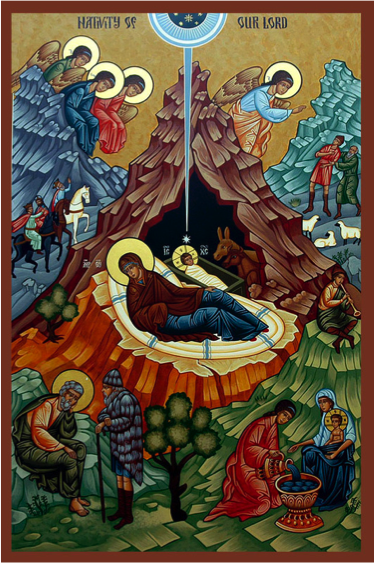 In a few days we will experience the coming of the Light on Christmas Day. Jesus Christ, “the light of the world” (cf. John 8:12) will enter into our darkness. He doesn’t enter in an explosion of light, a “big bang,” or a fiery descent from the heavens. Instead, Jesus comes to us much like that sliver of light that entered into my childhood bedroom. He chooses to bring His light to us as a baby, small and vulnerable, yet with a radiance that lets us know there is safety, comfort and love just within our reach. The icon of The Nativity of Our Lord illustrates this by its extreme contrast of dark and light. In the center of the icon is the cave with its rough-hewn, jagged edges. The cave is not just dark, but pitch black. It is an impenetrable darkness that leaves the viewer with the ominous feeling that no light could possibly breach it. It instills a sense of fear and despair. Yet this darkness represents not only the death and sin that has held us captive since the fall of our First Parents, but the grief, pain and insecurity we each carry. Those craggy edges are the obstacles we face both from without, and from within ourselves.
Just outside the cave lies the Child, the Source of Light that illumines the rest of the icon’s landscape. How can one so little generate enough light to make even the darkness of the cave seem inconsequential? How can such weakness and vulnerability be God’s powerful answer to sin and death? This is the mystery of our salvation, the mystery of Christmas – and the mystery of a tiny beam of light coming from a place of love that can wash away the fear of the dark. The Evangelist tells us, “There is no fear in love, but perfect love drives out fear because fear has to do with punishment, and so one who fears is not yet perfect in love.” (1 John 4:18) Love illuminates the darkness, overpowers fear, and is strong enough to defeat death. Not just any love can do something so marvelous, however; only the One who is Love has that authority.
The Child Jesus enters our dark world as that beam of Light that appears so insignificant, yet somehow comforts us, gives us peace, and reassures us that salvation is upon us. The Baby Jesus in the icon is not wrapped in the sweet “swaddling clothes” of a Christmas carol, but in the tightly bound cloth of a burial shroud, reminding us that His light can only fully enlighten the world and definitively cast out the darkness after it has first been extinguished on the Cross. This Baby Jesus is vulnerable, and He too is pursued by the darkness of the cave, which doesn’t yet recognize the Light. This Baby Jesus lived and grew under the heart of Mary, and emerged from her to reintroduce Love into the world. It is this same Baby Jesus who desires to live and grow in our hearts, from where His Light can emerge and radiate out to all whom we encounter. This “littlest One” is born in the darkness in order to bring us fully into the Light.
As a grown up I usually sleep better in a darkened room. But even now, knowing that there is a Light spiritually bathing me in Its warmth fills me with the comfort I felt as a child. Perhaps that’s because I am a child: a child of God who is King of Kings, Prince of Peace, and the Light who outshines even the coldest, scariest darkness.
The light shines in the darkness, and the darkness has not overcome it. John 1:5
Ann Koshute teaches theology for Saint Joseph’s College Online.

 ions of the Christian life. Preparation is a contemplative act in that we are drawn deeper into the mystery of the unfolding plan of salvation. Coming to know the Lord in prayer is the surest way to be confident we will recognize the Lord when he comes. Serving the Lord is the other dimension of preparation. Oil, in the parable, is symbolic of works of love, and so the subtle message of the parable is that at the eleventh hour, the foolish women could not borrow the good works of their wise sisters! At the heart of Christmas is the exchange of gifts—material and otherwise that really are signs of the love we have for those receiving the gifts we share. The poem below captures this so beautifully: