Peace on Earth in the New Year

Happy New Year! Many of us have established New Year’s resolutions to address self-improvement. Perhaps it’s time to take off a few pounds, or exercise more. Whatever your reasons, you are looking to self-improve. In true Christian fashion, we also take this time of year to express our hopes and dreams for improvement outside of ourselves, extending to our communities, society and the world. Many of us hope for world peace; a peace on earth that extends to all people of good will.

With every generation, we state that peace has never been needed more than today. That is because humanity, due to our concupiscence, sins. When we sin, we cause pain for ourselves and others, resulting in a deprivation of peace. When sin is allowed to permeate our lives, we crowd out Christ’s peace. For when we sin, we turn our backs on God, the giver of grace, love and all that is good.

When we look at the evils that permeate society, (wars, conflicts, human trafficking, slavery, domestic violence, murder, to name a few), we tend to feel helpless as individuals. We think that any solution is far too complex for any one person to resolve, thus the feeling of helplessness surfaces. Rather than looking outward for a solution to bring about world peace, may I suggest that you look inward? Identify your own sinfulness. Confess your sins and receive Christ’s peace. For, it is as an individual that you will find the path to peace – a peace for yourself, your community, society and the world.
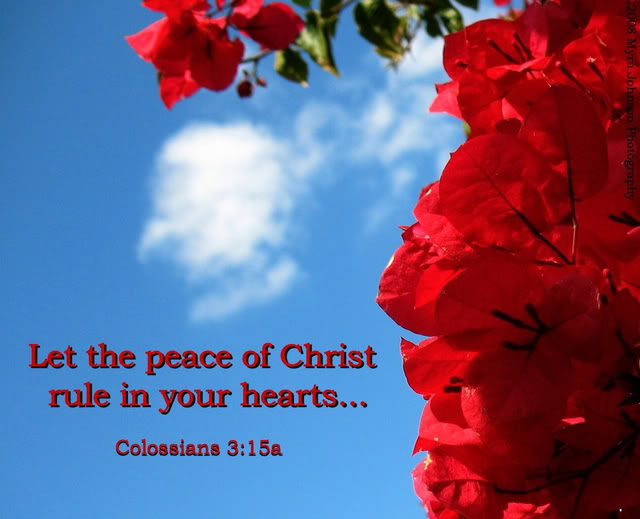
peace-of-christWhen we have conformed ourselves to Christ and received His Peace, we are enabled by Him to spread His peace to others. Peace is both a virtue and a fruit of the Holy Spirit. By conforming ourselves to Christ, we embrace the virtue of peace, and allow Christ’s peace to work within us. By the very nature of our Christian witness, we shine like a beacon of peace, drawing the oppressed to the light of Christ. Our actions, in the form of kindnesses extended to others, bear the fruit of the Holy Spirit, bestowed upon humankind. As the oppressed draw near, we are able to spread Christ’s peace through our very actions.

It is very important to remember that we are all created in the image and likeness of God. The Divine Indwelling resides within every person. Therefore, everyone deserves to be treated with dignity, regardless of status in life. When we disrespect another human being, we disrespect God. When we show compassion and empathy toward our neighbor, we show love for God and neighbor. It is with this love that all people of good will may demonstrate true inner peace – the Peace of Christ.

So, my friend, the path to peace starts with you! Find it within you to be that beacon of Christ’s light. Alleviate the suffering of the oppressed through small acts of kindness. Watch as the good ripples of peace emanate from your being as the fruit of the Holy Spirit blossoms. Christ’s Peace be with you!

Virginia Lieto teaches in the Catechetical Certificate Program for Saint Joseph’s College Online.
Christmas Octave Saints, Liberal Arts, and the Problem of Suffering

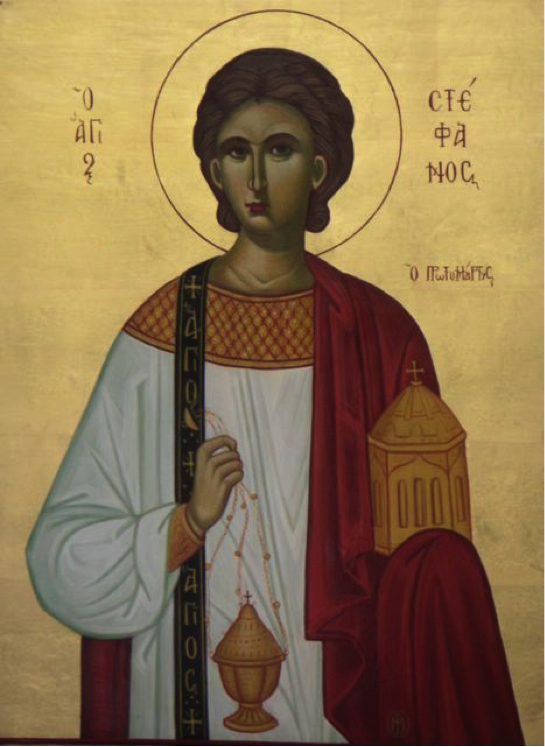
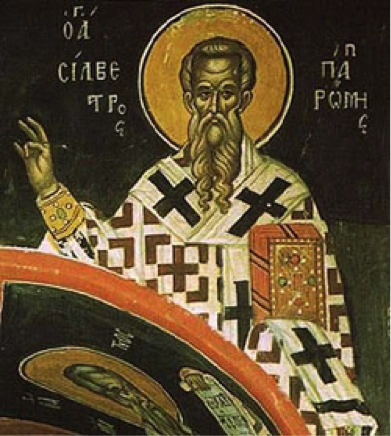
St. StephenThe week after Christmas begins with the liturgical celebration of St. Stephen, martyred as a young man, and ends with the celebration of the long-lived Pope St. Sylvester. But St. Sylvester could very well have become a martyr, having begun his papacy just before the Emperor Diocletian’s widespread, horrific persecution of the Church. Both men braved the demands of leadership and the possibility of death for their faith and for those whom they led.

How might they have prepared themselves to confront suffering and death? The scant information about either man’s life makes it impossible to know much. As a theology professor, I wonder if education had a role. St. Stephen’s brilliant defense of the Gospel before the Sanhedrin leads some to think he might have studied under Gamaliel. St. Sylvester, a Roman, might have received a liberal arts education and in any case governed St. Sylvestera Church led by bishops like St. Athanasius and Eusebius of Caesarea, whose family background, work, and writings give telling signs of their liberal arts training.

Ancient Roman culture relied on the liberal arts education to prepare its leaders, but today we struggle to show its practical value or wonder if it should have any. To enlarge my own perspective, I have begun reading through The Liberal Arts Tradition: A Documentary History, edited by Bruce Kimball. In his introduction Kimball explains that some have held the liberal arts tradition to teach an ideal conception of the human person, others have held it to teach eloquence through the study of language, literature, and rhetoric, and still others have held it to pursue knowledge of the truth of things, especially of the human person.

While recognizing the value of each of these three approaches, Catholic theological and philosophical traditions lean upon the last one because it seeks to know perennial qualities of reality, often denoted by “nature,” as in human nature. Belief in God encourages this search for the perennial qualities of things, which are created “good” by God. What is this goodness?

Let us consider another of these “big questions”— “What follows this earthly life?”—to illustrate the kind of thinking that the liberal arts wedded to the Catholic tradition seeks to promote. A liberal arts approach will examine various responses to this question and their implications. We can compare two approaches to care for the dying, one recognizing a Christian vision of the afterlife, Midwife for Souls: Spiritual Care for the Dying by Kathy Kalina, and a secular vision that remains agnostic, Living at the End of Life: A Hospice Nurse Addresses the Most Common Questions by Karen Whitley Bell.

In a nutshell, here is the difference between these two views of dying. If one does not recognize any life after death, then dying is about finding and celebrating a new depth of meaning in the life one has lived, as Bell illustrates:

For now, what I’ve come to understand is that we live among people who understand, not what will be after the last breath, but what can be with this breath, for this life, this moment. They live with a clarity of purpose, with compassion, kindness, and grace.… From them I’ve learned that it’s possible to live that afterlife – that paradise, that heaven, that rebirth – to forge a better existence, now (202).

By contrast, if one recognizes an actual life beyond this one, then dying can be a preparation for that life, even if one’s last years or months also involve discerning and celebrating the meaning of one’s earthly life. It is the time when the person not only detaches from this life but attaches to the next.

The “spiritual tools” of the caregiver help the dying examine their lives, and therefore easily draw upon the liberal arts tradition of leading an “examined life.” I do not know whether Kalina or Bell ever pursued such an education, but I do know that the liberal arts tradition offers rich versions of the spiritual tools each offers.

Take narrative for example. Bell teaches spiritual lessons primarily by telling the stories of her patients. She then adds open questions, often suggested by the stories and designed to help people explore their deepest values. Kalina too encourages the practice of “life review, sorting out the events of life and finding meaning” (20).

Given her theological convictions, Kalina’s primary tool is prayer and her primary narrative is scripture. Only God overcomes sin and brings the person into union with Himself. The caregiver asks God to receive the dying person into heaven and to help her help the dying and their families perform the spiritual work of preparation. For example, Kalina observes that some patients begin to moan at the very end of the dying process. She does not assume that this moaning is caused by pain because she knows from scripture that it could be the work of the Holy Spirit within the person: “as St. Paul explains in the Romans 8:26, ‘when we do not know how to pray properly, then the Spirit personally makes our petitions for us in groans that cannot be put into words’” (35-36). When Kalina hears this groaning, she first looks for indications that it has caused by pain. But if there are no such indications, she does not try to quiet the moaning and instead prays with the Spirit in the dying person. It might do productive spiritual work.

Whether one encounters the dramatic martyrdom of St. Stephen or the many trials of St. Sylvester, one handles suffering and death better with some personal preparation and with the help of others. The liberal arts tradition remains well equipped with narratives expressing the meanings people have found in life, suffering, and death.

Grattan Brown teaches Ministry to the Sick and Dying for Saint Joseph’s College Online.